The efficiency of your air conditioning system is inextricably linked to the quality of the air it processes.
When indoor air quality (IAQ) is compromised, your HVAC system struggles, leading to increased energy consumption and reduced comfort.
Consider the air circulating through your home. Dust, pollen, pet dander, and other airborne particulates are constantly present, especially in arid, windy desert environments.
These particles not only affect the air we breathe but also impact the mechanical components of our cooling systems. A clean system is an efficient system, and maintaining optimal IAQ is a cornerstone of HVAC performance.
- post content
- Understanding Static Pressure and Airflow
- Advanced Filtration Strategies for Desert Homes
- Integrating Whole-Home Ventilation and Humidity Control
- Smart Thermostat Scheduling for Air Quality and Efficiency
- FAQs: Indoor Air Quality
- conclusion
- view notes:collective tips
- view analysis:Combating Indoor Air Pollution
- view ideas:latest remodeling analysis
Understanding Static Pressure and Airflow
One crucial factor in HVAC efficiency is static pressure, which refers to the resistance to airflow in your ductwork and system components. When filters are clogged, ducts are leaky, or coils are dirty, the static pressure increases.
This forces your blower motor to work harder to push or pull air through the system. This increased effort translates directly into higher electricity usage and accelerated wear and tear on your equipment.
An HVAC system is designed to operate within specific airflow parameters. When airflow is restricted due to high static pressure, the system cannot distribute conditioned air effectively throughout your home.
This leads to uneven cooling, hot and cold spots, and a general feeling of discomfort, even when your thermostat is set to an appropriate temperature. The blower motor continuously tries to compensate for this resistance, becoming less efficient and consuming more power than necessary.
This constant strain can also shorten the lifespan of your unit, leading to costly repairs or premature replacement. Our goal is always to ensure your system can breathe easily, delivering consistent thermal comfort without undue energy waste.
-
How Airborne Particulates Strain Your System
The desert environment, with its fine dust and frequent winds, presents unique challenges for indoor air quality. Airborne particulates, even those invisible to the naked eye, are a primary culprit in reducing HVAC efficiency.
As your system draws in air for cooling, these particles inevitably accumulate on critical components like the evaporator coils and heat exchangers.
Over time, this dust accumulation forms an insulating layer on the coils. Evaporator coils are designed to absorb heat from your indoor air, and a layer of grime severely impedes this heat transfer process.
When the coils cannot efficiently extract heat, your air conditioner has to run longer and work harder to reach and maintain your desired temperature. This directly impacts your cooling capacity, meaning your system may struggle to cool your home effectively, especially during peak desert heat when outdoor temperatures can exceed 110°F.
Furthermore, this buildup can restrict airflow across the coils, exacerbating the static pressure issues mentioned earlier. The combination of reduced heat transfer and restricted airflow significantly drives up energy consumption.
Studies suggest that dirty coils can reduce efficiency by a notable percentage, directly translating to higher monthly cooling bills. Regular maintenance and effective filtration are therefore not just about cleaner air, but about protecting your investment and ensuring your system operates at its peak.
the complete review of HVAC systsms

What Does HVAC Mean? Why HVAC is a Vital Component for Your Home
Understanding a home HVAC (Heating, Ventilation, and Air Conditioning) system is essential for ensuring comfort, energy efficiency, and proper indoor air quality in your living space.

Advanced Filtration Strategies for Desert Homes
Given the unique challenges of desert climates, where fine sand, dust, and pollen are prevalent, advanced filtration strategies are not just a luxury but a necessity for maintaining both indoor air quality and HVAC efficiency.
Standard filters often fall short in capturing these microscopic invaders, allowing them to circulate through your home and accumulate within your HVAC system.
High-efficiency filtration systems, such as those utilizing higher MERV (Minimum Efficiency Reporting Value) ratings or even HEPA (High-Efficiency Particulate Air) filtration, are designed to capture a much broader spectrum of airborne contaminants.
MERV ratings indicate a filter’s ability to capture larger particles, with higher numbers signifying greater filtration capability. For instance, a filter with a MERV rating of 11-13 is effective at trapping pet dander, mold spores, and fine dust, while HEPA filters can capture nearly all particles, including bacteria and viruses.
By upgrading your filtration, you create a cleaner, healthier indoor environment, reducing the presence of airborne allergens and irritants common in desert regions.
-
Balancing Filtration Efficiency and System Airflow
While the appeal of higher MERV filters for superior air cleaning is strong, it’s crucial to understand the balance between filtration efficiency and system airflow. A filter with a very high MERV rating, while excellent at trapping small particles, also presents greater resistance to airflow.
This increased resistance, or pressure drop, can strain your HVAC system, particularly the blower motor. If your system isn’t designed to handle the increased pressure, it can lead to reduced airflow, decreased cooling capacity, and higher energy consumption as the motor works harder.
This is where understanding your specific HVAC system becomes vital. Modern systems, especially those with variable-speed blowers, are often better equipped to handle higher MERV filters (typically MERV 11-13) without significant performance degradation.
Variable-speed blowers can adjust their speed to maintain consistent airflow, even with a denser filter. However, older or single-speed air handlers might struggle, potentially leading to premature motor wear or even system overheating.
We always recommend consulting with an HVAC professional to determine the highest MERV rating your specific air handler can efficiently support, ensuring you achieve optimal air purity without compromising system performance or energy efficiency.
-
The Role of Media Air Cleaners in Protecting Equipment
Beyond standard disposable filters, media air cleaners play a significant role in enhancing indoor air quality and protecting your HVAC equipment, particularly in dust-prone desert environments.
These systems are typically installed in a dedicated cabinet adjacent to your furnace or air handler, providing a much larger filter surface area compared to traditional 1-inch filters.
This larger surface allows for superior particle capture without significantly increasing static pressure, striking a better balance between filtration efficiency and airflow.
Media air cleaners often utilize pleated filters with MERV ratings ranging from 11 to 16, effectively trapping fine dust, pollen, pet dander, and even some bacteria and viruses. By capturing these contaminants before they can reach the delicate components of your HVAC system, media air cleaners prevent dust accumulation on evaporator coils and blower motors.
This protection is critical for maintaining efficient heat transfer and preventing the efficiency losses associated with dirty coils. Moreover, they extend the lifespan of your primary HVAC system by reducing wear and tear caused by airborne debris.
While they require periodic maintenance, typically every 6-12 months depending on household conditions, these maintenance intervals are often less frequent than those for standard filters, offering both convenience and superior protection.
Integrating Whole-Home Ventilation and Humidity Control
In desert climates, where outdoor air is often dry and dusty, the concept of whole-home ventilation might seem counterintuitive. However, it’s a critical component of maintaining healthy indoor air quality and overall HVAC efficiency.
Modern homes are built to be tightly sealed for energy efficiency, which is great for keeping conditioned air in, but it can also trap indoor pollutants like volatile organic compounds (VOCs), pet odors, and excess moisture.
Mechanical ventilation systems introduce controlled amounts of fresh outdoor air while exhausting stale indoor air, ensuring a continuous supply of clean air without compromising thermal comfort or energy usage.
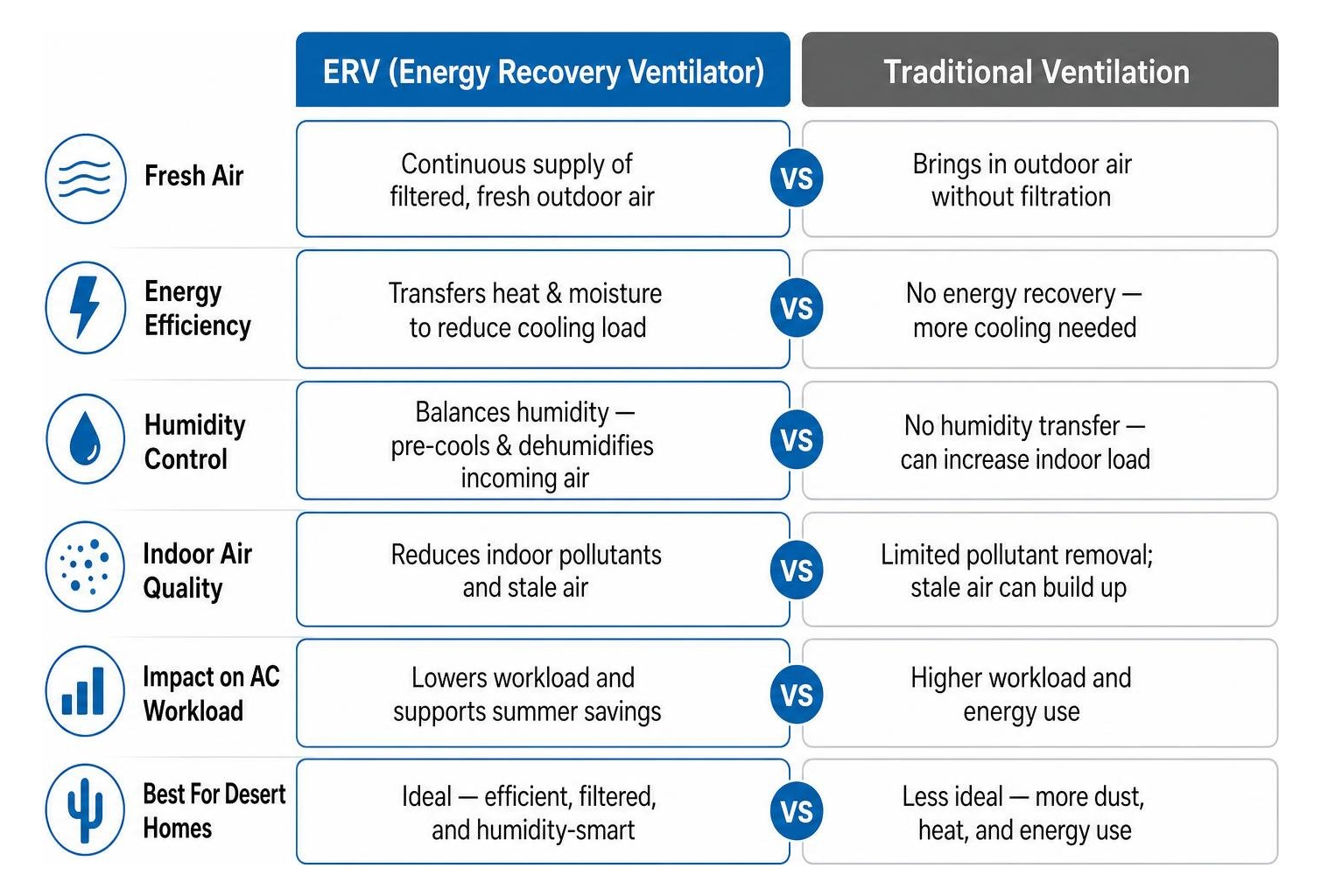
Energy Recovery Ventilators (ERVs) are particularly well-suited for desert environments. These systems not only exchange indoor and outdoor air but also transfer heat and moisture between the incoming and outgoing air streams.
In summer, an ERV can pre-cool and dehumidify incoming fresh air using the outgoing conditioned air, significantly reducing the load on your air conditioner. This means you get the benefits of fresh air without the energy penalty of conditioning completely new, hot, and dry air from outside.
This approach helps maintain balanced ventilation, which is vital for preventing negative pressure issues that can draw in unconditioned air or outdoor dust through cracks and crevices.
-
Managing Indoor Air Quality in Arid Climates
The arid nature of desert climates presents distinct challenges for indoor air quality. While humidity is generally low, the pervasive fine dust and allergens from the outdoor environment can easily infiltrate homes.
Effective management requires a multi-pronged approach that goes beyond just filtration. Balanced ventilation, facilitated by systems like ERVs, is key to continuously diluting indoor pollutants and maintaining a healthy exchange of air.
Without proper ventilation, pollutants like cooking fumes, cleaning product chemicals, and pet dander can accumulate to unhealthy levels.
Additionally, managing dust infiltration is paramount. Even with the best filters, microscopic desert dust can find its way indoors through leaky windows, doors, and other structural gaps. Sealing these potential entry points is a crucial first step.
When considering fresh air intake, ensure that any incoming air is properly filtered before it enters the living space. Exhaust fans in bathrooms and kitchens also play a vital role in removing localized pollutants and excess moisture at the source, preventing them from spreading throughout the home.
By combining robust filtration with controlled, balanced ventilation, we can effectively combat the unique IAQ challenges of desert living.
-
Humidity Optimization for Perceived Cooling Comfort
While desert air is typically dry, understanding and optimizing indoor humidity levels is still crucial for perceived cooling comfort and energy efficiency.
In very dry conditions, the human body’s natural evaporative cooling process works more effectively, meaning we can often feel comfortable at higher thermostat settings if the air isn’t excessively dry.
However, if indoor air becomes too dry, it can lead to discomforts like dry skin, irritated sinuses, and static electricity.
The goal is to find a comfortable balance. When your AC system runs, it naturally removes some moisture from the air (latent heat removal). By maintaining appropriate humidity levels, typically between 30-50% relative humidity, we can set our thermostats a few degrees higher without sacrificing comfort.
For instance, in a dry desert climate, 78°F with 35% humidity might feel as comfortable as 74°F with 50% humidity. This ability to raise the thermostat setting directly translates to energy savings. Our research shows that for every degree you set your thermostat above 80°F, you can save approximately 2% to 3% on cooling costs.
By focusing on sensible heat (temperature) and optimizing latent heat (humidity) removal, your system can operate more efficiently, leading to significant summer savings.
something of interest below

Combating Indoor Air Pollution for Better Home Improvement
We tend to associate air pollution primarily with exhaust fumes or industrial emissions, but the truth is, that the air inside our homes can be just as tainted, if not more so.
Smart Thermostat Scheduling for Air Quality and Efficiency
Smart thermostats have revolutionized how we manage home comfort and energy use, offering advanced features that are particularly beneficial in extreme desert climates. These devices go beyond simple programming, allowing for dynamic adjustments based on occupancy, weather, and even utility rates.
For optimal summer savings in the desert, a smart thermostat is an invaluable tool. It enables us to implement sophisticated schedules that balance comfort, energy efficiency, and indoor air quality, which is especially important during the long, hot cooling season that can run for six to eight months in areas like Las Vegas.
A properly programmed smart thermostat can cut Las Vegas cooling bills by 23-30%, potentially saving homeowners $400-$600 per year. These savings are achieved by strategically adjusting temperatures throughout the day.
For instance, setting the thermostat to 78°F during the day when home is a good baseline, but raising it to 82-85°F when the home is unoccupied can significantly reduce energy consumption. During nighttime, a setting of 74-76°F often provides ideal sleeping comfort without excessive energy use.
Smart thermostats also offer features like geofencing, which automatically adjusts settings based on your proximity to home, and learning algorithms that adapt to your routine, ensuring you’re only cooling when and where it’s truly needed.
This level of precision helps avoid the common mistake of over-cooling an empty house or running the AC unnecessarily.
-
Optimizing Fan Run Modes for Continuous Filtration
Beyond temperature control, smart thermostats offer advanced fan control options that can significantly impact both indoor air quality and energy consumption. The “Auto” fan mode is generally the most energy-efficient choice, as it only runs the fan when the cooling or heating system is actively operating.
This conserves electricity and allows the evaporator coil to properly drain condensate, which is important for humidity control and preventing mold growth.
However, in desert environments with high levels of airborne dust and allergens, or when aiming for continuous air circulation and filtration, the “Fan On” or “Circulation” modes can be beneficial.
While running the fan continuously (“On” mode) will increase your electricity bill (potentially $30-$50 per month), it provides constant air turnover, pushing air through your filtration system more frequently.
A better compromise is often the “Circulation” mode, available on many smart thermostats. This mode runs the fan periodically (e.g., 15-20 minutes every hour) to gently circulate air and enhance filtration without the constant energy drain of “On” mode.
This strategy helps maintain a more consistent temperature throughout your home and improves air purity, especially when paired with a high-efficiency media filter. By optimizing fan run modes, we can ensure that your home’s air is continuously being cleaned, contributing to a healthier indoor environment.
-
Coordinating Ventilation with Time-of-Use Utility Rates
In regions like Nevada, utility providers such as NV Energy often implement time-of-use (TOU) rate structures, where electricity costs vary significantly throughout the day, with peak hours being the most expensive.
This pricing model presents a unique opportunity for smart thermostat users to maximize savings by coordinating their cooling and ventilation strategies with these rates.
The core strategy involves “pre-cooling” your home during off-peak hours when electricity is cheapest.
For instance, if peak rates start at 1:00 PM and end at 7:00 PM, you can program your smart thermostat to lower your home’s temperature to 74-76°F during the morning (e.g., 6:00 AM – 1:00 PM).
This banks thermal energy in your home’s structure and contents, allowing it to “coast” through the expensive peak hours with a higher thermostat setting (e.g., 78-80°F). During these peak hours, the AC will run less frequently, or even not at all, significantly reducing your energy costs when electricity is most expensive.
This approach can lead to substantial savings, with some homeowners reporting monthly reductions of $50-$130 during peak summer months, totaling over $500 in savings per season.
Smart thermostats equipped with learning capabilities or remote access allow for easy adjustment of these complex schedules. They can also integrate with demand response programs offered by utilities, further incentivizing energy conservation during peak periods.
By strategically managing your cooling and ventilation to align with TOU rates, you can maintain comfort, improve indoor air quality through consistent air circulation, and achieve remarkable energy savings.
Dry Landscaping
Living in a dry environment calls for thoughtful landscaping that conserves water while maintaining beauty and functionality.
Xeriscape landscaping principles emphasize using drought-resistant plants, minimizing turf areas, and implementing efficient irrigation techniques.
By incorporating native and low-water-use plants, as well as designing with soil and climate considerations in mind, xeriscaping provides a sustainable solution for creating an appealing and eco-friendly yard in arid regions.
view ideas: Practical Xeriscaping Ideas (new win)

Frequently Asked Questions About Indoor Air Quality
Homeowners in desert climates often have specific questions about how to best manage their indoor environment.
We’ve compiled some of the most common inquiries regarding indoor air quality, HVAC efficiency, and thermostat settings to help you navigate the summer heat.
-
How does indoor air quality affect my monthly cooling bills?
Indoor air quality directly impacts your cooling bills primarily through the efficiency of your HVAC system. When your indoor air is laden with dust, dirt, and other particulates, these contaminants accumulate on your air filter, evaporator coils, and blower motor.
A dirty filter restricts airflow, forcing your system to work harder and consume more electricity. Accumulated grime on evaporator coils acts as an insulator, reducing the system’s ability to absorb heat from your home, meaning it has to run longer to achieve the desired temperature.
This increased workload and decreased efficiency translate directly to higher energy consumption and, consequently, elevated monthly cooling bills. Maintaining good IAQ through proper filtration and ventilation ensures your system operates as intended, minimizing energy waste.
-
What MERV rating is best for balancing air purity and HVAC efficiency?
For most residential HVAC systems in desert climates, a MERV rating of 8 to 11 strikes an excellent balance between air purity and system efficiency.
Filters in this range are effective at capturing a significant portion of common airborne particles, including fine dust, pollen, pet dander, and mold spores, which are prevalent in arid environments. While higher MERV ratings (13+) offer superior particle capture, they also create greater airflow resistance.
If your HVAC system, especially older models or those with single-speed blowers, isn’t designed to handle this increased pressure drop, it can lead to reduced airflow, decreased cooling capacity, and increased strain on your blower motor, ultimately raising energy costs and potentially shortening equipment lifespan.
Always consult with an HVAC professional to determine the maximum MERV rating your specific system can efficiently support.
-
Can a smart thermostat help manage both home comfort and air cleanliness?
Absolutely. Smart thermostats are powerful tools for managing both home comfort and air cleanliness. Beyond their advanced temperature scheduling capabilities, many smart thermostats offer features that directly contribute to better indoor air quality.
They can be programmed to run the system’s fan periodically (e.g., 15-20 minutes every hour) even when the AC isn’t actively cooling. This “fan circulation” mode continuously moves air through your filtration system, enhancing air purity by capturing more airborne particles.
Some advanced models can even integrate with indoor air quality monitors, providing alerts or automatically triggering ventilation systems when pollutant levels rise.
By optimizing fan runtimes, coordinating with whole-home ventilation systems, and allowing for precise temperature control, a smart thermostat helps create a consistently comfortable and healthy indoor environment while simultaneously maximizing energy efficiency.
Conclusion
Mastering your home’s indoor environment in the challenging desert climate requires a holistic approach that seamlessly integrates thermostat settings, advanced air quality strategies, and diligent HVAC maintenance.
We’ve seen how the simple act of optimizing your thermostat settings for daytime, nighttime, and unoccupied periods can lead to substantial summer savings, with some homeowners cutting their cooling bills by 23-30% annually.
Leveraging smart thermostat features like geofencing, learning algorithms, and strategic pre-cooling in conjunction with utility time-of-use rates can transform your energy consumption patterns.
However, true comfort and efficiency extend beyond just temperature. A healthy home environment is one where indoor air quality is prioritized.
By understanding the critical link between airborne particulates and HVAC performance, implementing advanced filtration strategies, and integrating whole-home ventilation and humidity control, we can ensure our systems run efficiently while providing clean, fresh air.
Maintaining proper system balance through regular preventive maintenance—including cleaning or replacing filters, inspecting coils, and sealing ductwork—is paramount for long-term efficiency and extending the lifespan of your equipment. Achieving Clean air cooling savings is a realistic goal for every desert household.
Achieving a cool, comfortable, and healthy home in the desert doesn’t have to break the bank. By adopting these integrated strategies, we empower ourselves to enjoy significant energy savings, breathe cleaner air, and ensure our HVAC systems operate at their peak performance for years to come.
home improvement ideas to consider (complete directory – new win):


Find HVAC Services Air Conditioning Central Heating Ducts & Vents Insulation Thermostats Water Heaters top-rated, pre-screened local contractors FREE: download contractor selection enter zip code – powered by HomeAdvisor ™


Image credit: by envato.com
end of post … please share it!
| more photo remodeling |
Jump Over to Our Photo Analysis Center for Ideas on
"Renovating Home"
|__________________________________________________________|
home remodeling surprise
find out where it might go - new win


Helpful article? Leave us a quick comment below.
And please share this article within your social networks.