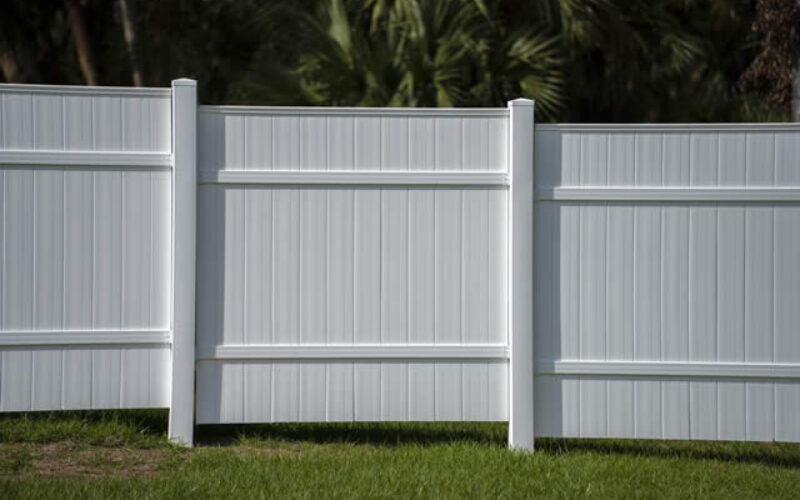
Add a walk gate or quote a short 25-foot side run and the per-foot figure climbs again.
In the guide below, we surface every hidden cost, explain how gates distort the math, and map the local rules you’ll need to clear so you can budget without surprises.
- post content
- Vinyl Fence Cost in Los Angeles at a Glance
- Why Short Runs Under 100 Feet Cost More per Foot
- How Local Fabrication and Stocked Material Affect Turnaround
- Gate Costs Can Dominate Your Vinyl-Fence Budget
- Permits and Fence Codes Vary Across Los Angeles County
- Vinyl vs. Wood, Composite and Aluminum in Southern California
- How to Lower the Cost Without Creating Permit Problems
- FAQs
- conclusion
Vinyl Fence Cost in Los Angeles at a Glance
Here’s the quick math you’ll walk through with any installer. Match your project to a row, then keep reading for the factors that push these numbers higher or lower.
| Scope | Planning range | What it covers | What stays extra |
|---|---|---|---|
| National 2025 materials only (Fixr) | $10-$30 / ft | Boards, rails, posts on the pallet | Labor, concrete, delivery |
| National 2025 installed range (Fixr) | $15-$40 / ft | Materials plus average U.S. labor | LA wage premium, permits |
| Old-fence removal | $2-$5 / ft | Tear-out and haul-off | Buried concrete, masonry |
| Walk gate | $200-$1,100 | Gate leaf, hinges, latch | Self-closing kit, code signs |
| Double drive gate | $500-$2,000 | Two leaves, reinforced posts | Drop rods, center stop |
| Sliding/rolling driveway gate | $1,800-$7,650 | Gate, track, basic install | Operator, power, drainage |
| Automatic vinyl gate | $750-$5,600 | Gate plus entry-level operator | Conduit, keypad, permits |
All rows rely on Fixr’s 2025 national cost guides; Los Angeles labor and permit costs can push local quotes higher.
Use these bands as a compass, not a contract; a steep slope, custom gate, or last-minute permit can still nudge your quote beyond the range. We break down every price driver next so you can keep budget creep in check from the first quote.
-
Height, Style, Color and Material Grade
A six-foot solid privacy panel is the city’s typical choice because it shields yards from the street. Switch to a picket or ranch rail and you use fewer boards, posts, and concrete, which lowers cost with every linear foot.
Costs climb just as quickly in the other direction. Lattice caps, scalloped pickets, or curved rails need extra fabrication. Swap factory white for espresso, clay, or faux-wood and expect to pay more than for basic white vinyl. That premium pays for UV stabilizers, matching cap stock, and the quality checks that keep color from chalking in the August sun.
Material grade finishes the price story: thicker posts resist coastal winds and gate weight but require more resin. Thin economy panels may look fine on day one yet flex under pressure and rattle when the Santa Anas blow. Match height, style, color and product line across bids so you are not comparing a premium fence with a budget run.
-
Labor, Soil and Access
Labor often outweighs materials. According to the Bureau of Labor Statistics, construction and extraction jobs in Los Angeles averaged $37.00 an hour in May 2024, roughly 20 percent above the U.S. mean of $30.73. Add the city’s scheduled rise to an $18.42 minimum wage on July 1, 2026, and that difference shows up in every bid.
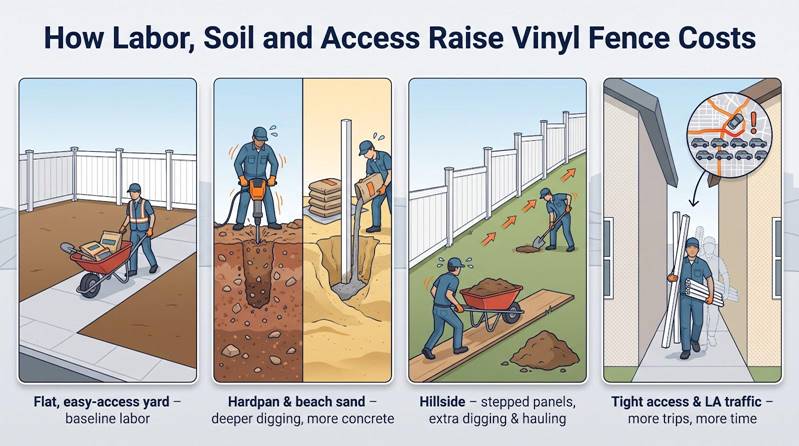
Site conditions layer on extra work. Hardpan or beach sand needs deeper holes and more concrete, while hillside lots demand stepped or racked panels plus spoil removal. Tight side yards force crews to hand-carry materials, and L.A. traffic can turn a quick supply run into a long detour.
-
What a Clear Quote Should Show
Ask for a line-item estimate that separates:
- posts and concrete
- fence panels
- each gate with its hardware
- demolition and disposal
- permit or HOA processing
- cleanup
Old wood with buried footings can cost more to remove than chain-link, and self-closing hardware can double a walk-gate price. A transparent quote shows where each dollar lands, and where you can trim without cutting corners.

Why Short Runs Under 100 Feet Cost More per Foot
-
Fixed Costs Don’t Shrink With Footage
Every fence, no matter how small, needs the same kickoff tasks: crew mobilization, utility marking, concrete mixing, and sturdy end posts. Add a walk gate with its reinforced hinge posts and you stack hundreds of dollars of hardware and labor into a stretch barely longer than a parking stall. On a 25-foot side yard, those non-negotiable tasks weigh four times heavier than on a 100-foot backyard. The footage shrinks, but the fixed costs stay full size.
-
Gate Allocation: Tiny Run, Huge Impact
A single walk gate runs $200-$1,100 installed, according to Fixr’s 2025 guide. Spread that across different run lengths and the per-foot burden looks like this:
Fence length One gate cost Added cost per foot 25 ft $200-$1,100 $8-$44 50 ft $200-$1,100 $4-$22 100 ft $200-$1,100 $2-$11 The math is simple: gate cost divided by total footage. Double the run and the pain halves; cut the run in half and it doubles. That is why corner dog runs or short side-yard enclosures often trigger sticker shock.
Slide the same gate into a long backyard line and the surcharge fades. If your layout is flexible, consider extending the fence across a broader stretch, or sharing a property-line project with a neighbor, to spread fixed costs across more feet.
How Local Fabrication and Stocked Material Affect Turnaround
Project calendars slip for two main reasons: parts sit on a truck crossing the country, or a custom gate waits in a distant queue. Partner with a crew that controls both steps, and the schedule tightens quickly.
Take Vinyl Fence Depot, a Southern California fence manufacturer and installer. The company custom fabricates components at its Van Nuys facility from U.S.-made rigid PVC it already stocks, which keeps wait times short. You avoid a week-long reschedule while new parts ship in. Stock profiles and colors are listed at www.vinylfencedepot.com
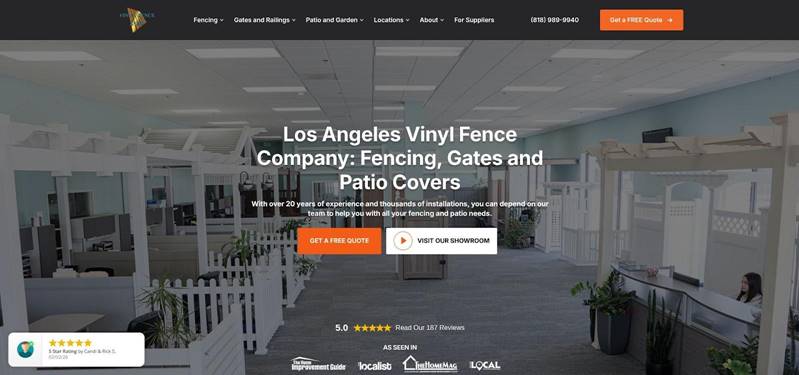
Vinyl Fence Depot Local Fabrication and Stocked Inventory Website Screenshot
When you interview bidders, ask three quick questions:
- Where will my fence be fabricated?
- Which profiles and colors are in stock today?
- How many extra days would a custom gate add?
Clear answers show the contractor truly owns the process and can meet the dates written into your contract.
Gate Costs Can Dominate Your Vinyl-Fence Budget
-
Single Walk Gate
A yard gate looks harmless on paper yet can rival a full panel row on the invoice. Plan on $200-$1,100 installed for a vinyl walk gate, the 2025 national benchmark from Fixr.
Width drives price, but hardware matters more. Self-closing hinges, keyed latches, or pool-code latch kits improve durability and safety, and each one appears line by line on the estimate. Count on reinforced gate posts, thicker rails that resist sag, and a solid concrete footing so the leaf keeps swinging true long after the barbecue smoke fades.
-
Double-Drive Gate
Need to pull a truck or boat trailer into the yard? A paired swing gate answers that need, and the price tag proves it. Budget $500-$2,000 installed for a vinyl set wide enough for most driveways, using Fixr’s 2025 national range as the baseline.
Two leaves double the hinge hardware and shift weight to beefier posts. Skilled crews reinforce each panel with an internal steel frame to keep the pair square, then add a drop rod and concrete center stop so wind cannot slam the leaves or rip out hinges.
A sloped driveway apron adds another wrinkle. If the concrete tilts toward the street, installers must either angle-cut the bottom rail or hang the gate higher. Both fixes take extra time. Ask each bidder which option they include and how it affects clearance for pets, kids, and rolling bins.
-
Sliding or Rolling Driveway Gate
A sliding gate trades swing clearance for track and hardware, which moves the cost from yard space to your ledger. Fixr lists a small vinyl slider at $200-$1,200 installed. That covers a side-yard width, a modest track, and basic rollers.
Openings wide enough for cars or trucks climb sharply. Fixr’s driveway-gate guide shows $1,800-$7,650 installed across materials for full-width sliders or rollers. The jump happens because you need a rigid steel frame hidden inside the vinyl skin and a level concrete or V-track kept clear of debris and drainage that stops gravel from jamming the wheels after the first storm.
On steep aprons, pros often switch to a cantilever design that hangs the gate on posts instead of rolling it on the slab. That layout removes track upkeep but adds steel, larger posts, and deeper footings. Sliding solves tight swing space, yet every extra inch of clear roll-back shifts cost from layout to budget, so confirm the trade-offs before you commit.
-
Automatic or Electric Gate
Automation turns a driveway gate into a push-button entry, but convenience carries a premium. Fixr’s 2025 data put a vinyl gate with a low-voltage swing operator at $750-$5,600 installed.
Electric drives require more than hardware. Crews trench or surface-mount conduit, pull power from the nearest sub-panel, and secure an electrical permit if the run is not just plugging into an existing outlet. Add a keypad or app opener and you introduce low-voltage wiring and Wi-Fi range checks.
Compliance matters, too. Operators should be UL 325-listed, frames must meet ASTM F2200, and gates across fire-access roads need an emergency override per the 2025 California Fire Code. Ask your installer to note each box as checked on the proposal before an inspector flags the new gate for a redo.
Permits and Fence Codes Vary Across Los Angeles County
-
City of Los Angeles
Los Angeles now follows two rulebooks at once: most properties still use the Original Zoning Code, while parts of Downtown and other pilot areas apply Chapter 1A. Always plug your address into the city’s ZIMAS map first, then read the code it returns.

Los Angeles ZIMAS Zoning Map Tool Screenshot for Fence Permit Checks
Under the Original Code, a residential front-yard fence tops out at 3.5 feet. Shift to a side or rear yard and you gain height: up to 6 or 8 feet, depending on the lot’s zone, under Section 12.22 C.20 of the zoning code. ZIMAS tells you which limit applies to your parcel.
Material drives permits. A wood or vinyl fence under 10 feet is usually exempt from a building permit, but masonry or concrete over 3.5 feet triggers a full structural review, per the Los Angeles Department of Building and Safety.
Exemption never overrides zoning. Permit-free fences must still respect height caps, driveway visibility triangles, and any overlay or specific plan that applies to your block.
Vinyl vs. Wood, Composite and Aluminum in Southern California
| Material | Why homeowners pick it | Trade-offs to budget for |
|---|---|---|
| Vinyl (PVC) | Low routine upkeep, crisp modern look, full-privacy styles; factory color holds without paint | Can soften or warp under extreme heat or wildfire exposure; repairs often mean swapping a whole panel |
| Wood | Warm natural grain; easy on-site trimming; individual boards replaceable | Needs paint or stain every few years; termites and decay can attack posts set in damp soil |
| Composite (wood-plastic) | Color-through boards resist splinters; no painting needed | Higher upfront cost than wood; caps can fade in full coastal sun if light on UV blockers |
| Aluminum | Lightweight, corrosion resistant and non-combustible, a plus near grills or stucco walls | Mostly open picket styles; dents under hard impact; coastal salt can pit lower-grade alloys |
Costs overlap more than ads admit. Fixr’s 2025 national installed ranges cluster around $15-$40 per foot for vinyl and aluminum and $22-$40 per foot for composite, while wood often starts near $15 per foot but climbs once you add stain cycles. In short, material price bands converge. Maintenance and code context make the real difference.
- Tight HOA palette? Vinyl or aluminum usually stays compliant with minimal fuss.
- Wildfire-prone hillside? A non-combustible aluminum picket may earn points with insurers and fire marshals.
- Love to tweak layouts every decade? Wood’s board-by-board repairability shines.
Price is only one leg of the stool. Match material to code, climate, and the time you are willing to spend on upkeep, and the right choice will reveal itself.
How to Lower the Cost Without Creating Permit Problems
-
Normalize Every Bid
Line up proposals foot for foot: same length, height, style, color, post size, concrete depth, and gate count, right down to the hinge grade. One contractor may fold demolition, survey, or permits into the total, while another leaves those items blank. Until every line shows included / allowance / excluded, you are comparing scope rather than price.
-
Reduce Costly Custom Elements
Lattice caps and eight-inch steel posts look great, yet each touch adds dollars to every foot. Stick to standard six-foot panels and factory stock colors (white, tan, clay) unless a design board or HOA requires more. Audit your gates as well: many yards work fine with one wider walk gate instead of a double-drive set. Fewer gates mean fewer reinforced posts, hinges, and alignment hours.
-
Prevent Rework
Building twice drains a budget fast. Before concrete hits the hole:
- Verify zoning with the city or ZIMAS map.
- Secure written HOA approval if required. California Civil Code §4765 requires HOAs to follow a fair, written review process.
- Call 811 at least two working days ahead so utilities can be marked.
- Confirm property lines. Walk the plat or order a quick survey.
Finally, confirm the installer’s license and insurance, and put every promise in writing. California caps a residential down payment at 10 percent of the contract or $1,000, whichever is less. A solid paper trail costs less than a tear-out.
Frequently Asked Questions
-
How much does 100 feet of vinyl fence cost in Los Angeles?
At Fixr’s 2025 national installed range of $15 to $40 a foot, a straight 100-foot run lands around $1,500 to $4,000 before gates or demolition, and Los Angeles labor and permit costs can push it higher.
-
Why does a 50-foot fence cost more per foot?
Fixed expenses such as crew mobilization, end posts, concrete, and cleanup stay about the same no matter the length. Divide those costs by fewer feet and the per-foot rate climbs.
-
How much does a vinyl gate add?
Plan on $200-$1,100 for a single walk gate and $500-$2,000 for a double-drive set, based on Fixr’s 2025 national data.
-
Do I need a fence permit in Los Angeles?
Often not. Most non-masonry fences under ten feet are exempt from a building permit. Zoning height caps, driveway visibility triangles, and overlay rules still apply. Always confirm the current requirement for your address.
-
Is vinyl cheaper than wood?
National 2025 installed ranges overlap. Vinyl and wood both start near $15 per foot, and many wood lines reach $35 per foot once labor is added. Wood can appear less expensive at first, but vinyl usually avoids the ongoing paint or stain cycle.
-
Can vinyl be used around a pool?
Yes, if the fence and self-closing gate meet California’s pool-barrier rules: at least 60 inches high, self-latching, with the latch 60 inches above grade, and no more than a two-inch gap at the bottom. Verify local amendments before ordering panels.
Wrapping Up
Vinyl fencing runs $15 to $40 a foot installed nationally, and Los Angeles labor and permits push local quotes higher. Gates, short runs, and code quirks can move that figure fast.
Measure twice, normalize every bid, and clear permits before concrete hits the hole. Ready for exact numbers?
Record your footage, snap site photos, and invite a licensed fabricator-installer to craft a line-item quote that stays honest from handshake to hand-off.
home improvement ideas to consider (complete directory – new win):


Image credit: vinyl fence cost by envato.com
end of post … please share it!
| more photo remodeling |
Jump Over to Our Photo Analysis Center for Ideas on
"Renovating Home"
|__________________________________________________________|
home remodeling surprise
find out where it might go - new win


Helpful article? Leave us a quick comment below.
And please share this article within your social networks.