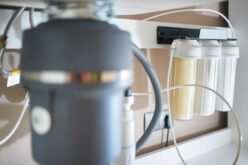
Their process of purification work on different bases and it would be wise to become familiar with their characteristics and then make the final decision. The next couple of lines will give you an unbiased comparison of the two, different than the majority of those that can be found online which take one side over the other.
Ultra Violet (UV) Filters
These filters provide effective sanitizing treatment by using ultra violet rays to inactivate bacteria and viruses. They basically attack their DNA and are very effective in stopping them reproduce. In this way you are protected from water-borne bacterial diseases. UV filtered water is chemicals-free, in addition to not giving your water any taste and odor, and requires very little energy and low maintenance.
There is no need for expert service when it comes to maintenance, it is quite simple. The only thing you need to do is change the UV bulb from time to time. Daily amount of purified water is not limited, as it is the case with RO filters. However, this system is not enough to provide you with completely clean water on its own since it less effective against inorganic impurities.
Reverse Osmosis (RO) Filters
As the name says the process that it is based on is opposite to osmosis. What it basically does is that it pushes pure water from the concentrated solution and you collected it downstream of the membrane. RO filters use membranes with a very tight pore structure thus being very effective in removing impurities from water, such as TDS (total dissolved solids), lead, asbestos and different toxic metals. Also, it is very effective against strontium and radioactive plutonium.
Additionally, it includes an ion exclusion process, meaning that dissolved molecules and ions get retained, including salts and sugars and even microbial particles such as bacteria. They will remove chlorinated pesticides too. However, due to process characteristics of reverse osmosis, the flow rate is slow and there are daily limitations in terms of the number of water gallons that can be obtained. In a recent conversation with my local reverse osmosis filter system suppliers, I learned that this type of filters is affordable and requires minimal maintenance, plus you can do all the maintenance yourself, just like with UV filters.
As you can see, RO and UV filters have their area of expertise. Each water purification method is successful in removing a specific impurity and none can be solely adequate to provide you with truly pure water. The best way to use them is to combine. On the other hand, if their individual characteristics are what you are looking for, hopefully this will help you decide. Once more, make sure you go through these lines carefully and you will be happy with the results.
|__________________________________________________________|
home remodeling surprise
find out where it might go - new win


Helpful article? Leave us a quick comment below.
And please share this article within your social networks.
.breaking-news {display: none !important;}